Actual email from this week:
From: Daniel
Sent: November 13, 2011 7:41 AM
Subject: Fee
Just watching the news where they say there would be NO fee for a Christmas tree at least for this year. I do think it is a religious discrimination.
Will there be a fee for raising goats or sheep that is used in the Islam religion?
Will there be a fee on the turkeys that are raised for Thanksgiving?
Sincerely,
Daniel
Wow, I couldn't even formulate a response to that one. Each year, there are only a handful of emails I just simply don't answer - and this was the first of 2011.
This whole Christmas Tree tax thing has broken down into the surreal on so many fronts. All because one blogger with some kind of ulterior motive decided to call the checkoff program a tax on trees, even though it isn't. Some people just simply refuse to see the facts, even when presented with them in a clear and concise manner.
I thought of an analogy for this:
If we go to the zoo and look at a giraffe, we're both looking at the same giraffe. But then you might say, "I think that's a mule."
I would respond, "No, it's not, it's a giraffe. We're both looking right at it, and mules are different from giraffes."
But you could still say, "I don't care. I think it's a mule and I'm going to call it a mule from now on no matter what you say."
And you do just that. You tell everyone who walks by that they're looking a mule. Maybe you even stand on a fencepost and shout it as loud as you can.
Well, that doesn't magically make the giraffe a mule just because you call it that. It just makes you wrong.
But the moral of this story is that unfortunately there are a lot of people out there who just believe what they are told. And if you tell them often enough and loud enough "that's a mule," some of them will believe you, even if they're looking right at the giraffe. For this audience, I just don't think it's worth it to keep replying, "It's not a tax" ... they're never going to believe us.
And then, the majority of people renew my faith. Here's a typical exchange:
From: Will
Sent: November 9, 2011 1:17 PM
Subject: the christmas tree tax
Last night when I first read about this, I KNEW it had to be some trade group behind this ... and it turns out it was YOUR group! Gee ... I wonder how much money you gave to or promised to give to Obama for this little favor ... hmmm.
And good thing it's been 'delayed." Why does your group even exist??? You're just trying to sponge off the taxpayers.
Here was my answer:
Agricultural producers have created promotional boards like this one since 1966, and they date back to the Johnson Administration. There are more than 20 such boards in existence currently, and some well-known promotional boards have developed successful advertising and promotion campaigns, including the "Got Milk?", "Pork: The Other White Meat" and the "Incredible Edible Egg."
There are zero tax dollars involved here. USDA bills all costs associated with these promotional efforts to the industry groups that create the boards.
These promotional boards are created when the industry gathers together and decide to petition USDA to create a promotional board. USDA reviews the petition, opens it up to industry and public comment, and then creates the board if it meets certain criteria. That is what happened here.
Fresh cut Christmas Tree producers have long been concerned about losing market share to artificial tree makers and foreign imports. In response, the domestic producers decided, as an industry and as is their right, to fund a promotional effort, similar to how the dairy processors created the "Got Milk?" campaign. They want to self-assess this 15-cent fee on domestic Christmas Trees for producers who sell more than 500 trees a year.
To ensure fairness, and as required by law, the USDA works with the industry at the start of this effort to ensure that consumers or growers are not gouged and to provide ongoing oversight to ensure the program meets its stated goals.
Many producers, from dairy farmers to livestock producers to blueberry growers, have created research and promotion boards because it increases their markets and they prosper.
Will wrote back:
From: Will
Sent: November 9, 2011 4:26 PM
Subject: RE: the christmas tree tax
Thanks for the reply. And I stand corrected re this being a tax. Thanks. But ... you gotta admit ... you've gotten some bad PR on this thing. Not a great time to be raising prices, or having your group tied to Obama. Anyway, good luck. And thanks again for the reply.
FWIW, I get a fresh tree every year.
Thanks, Will. It was folks like you who kept me going the past week or so.
Hey, I've got an idea. Next week, let's start talking about trees, shall we? We're only one week away from sales season opening. Woo-hoo!
Friday, November 18, 2011


Thursday, November 10, 2011
What the Checkoff Means to Me
A Guest Post from a Tree Farmer:
My husband and I have been in the Christmas Tree business since 1971, and I just wanted to take a moment to respond to some of the recent questions about the Christmas Tree checkoff. We are a small Christmas tree farm in the foothills of the Oregon Coast Range. We are primarily wholesalers, but have been retailers and now also have a small Choose & Cut operation. Our soils are suited to growing Christmas trees and not much else.
A checkoff is a program where commodity groups can help themselves to better their industry. A couple of the longest running ones are cotton and beef. They formed because there were incredible challenges in their industries that no one state or company could answer. When I was in high school, Sunday nights were spent ironing clothes for the next week at school. The cotton checkoff paid for the research that made permanent press cotton fabric possible. Do you remember how cotton clothes used to fade? The Cotton Checkoff paid for the research that paid for that, too. The cotton checkoff was formed because their industry was being overwhelmed by polyester fabric that didn't fade and didn't wrinkle.
By working together, industries such as cotton could pool their resources and speak with one voice. The assessment that is made is self-imposed funding by the industry to help itself. The monies are collected, and the program is designed and run by an industry board. Taxes are monies collected by the government for use by the government. Monies collected by checkoffs go directly to the checkoff to be used for research and promotion for that industry alone.
We petitioned the USDA as is our right under the First Amendment to the Constitution. We asked them to allow us to create a program, for which they would provide oversight. The industry pays for this oversight - it is revenue neutral to the government. The government doesn't get any of the money, and there is no cost to the taxpayer.
We did not do this lightly. It is a serious thing we were asking. The oversight is a good thing. A checkoff is audited annually. The checkoff boards must set goals to be met by the program. Every 5 or so years an econometric study must be done that tells whether or not those goals are met. If those goals are not met, the program folds. The USDA makes sure that money is used for what it is supposed to be used for.
A group of us growers and importers started more than three years ago in April of 2008 to study other commodities that have tried these programs. We focused on commodities that were similar in size: blueberries, mangoes, watermelons, sorghum and several others. We facilitated sessions in the four top growing areas of the country. By now there have been at least 100 meetings across the country at state and national Christmas tree meetings discussing the checkoff.
You asked how we can guarantee that the assessment would not be passed on to the consumer. We can't guarantee that. Each grower will make that decision. We are primarily wholesalers. In 2008, I contacted all our buyers, mostly retailers, and asked them how would they feel about this kind of promotion program and the assessment. They were all supportive and excited to get the kind of help in the marketplace that the checkoff could supply. Some offered to pay the whole thing, and some offered to split the cost, should it come into being.
Farmers know dirt. We know how to grow things. But in this changing world, is it not enough to grow a great product. We have to let people know about our product. That takes time, coordination and money.
Some people have asked why we don’t just pool our resources and keep USDA out of it. In the last 20 years, there have two very strong voluntary programs initiated by the industry that raised nearly a million dollars each. We have found, as every industry we studied found, that voluntary programs have a life of about three years. The volunteers running the program and paying into the program burn out. Everyone in the industry benefits, but only a few carry the burden. These two programs had great impact on our industry's ability to promote our product. We know promotion and research work. We have to do it as an industry to survive. A checkoff is fair, equitable and can supply sustainable monies.
Betty Malone, Sunrise Tree Farm
Wednesday, November 9, 2011
Don't Believe Everything You Read ...
The NCTA office has been busy this morning – even busier than usual this time of the year. In case you missed it (and at least according to Twitter, almost no one has), several news media reported that Obama had donned a Grinch outfit and swept in to ruin Christmas for everyone by instituting a Christmas Tree tax.
Raise your hand if you heard this story and worried about the effect it would have on your Christmas Tree this year … ok, you can put your hands down because we want to set the story straight. There is NO Christmas Tree tax.
Yesterday, the USDA announced a final rule for the Christmas Tree Promotion, Research and Information Order, also known as a checkoff program. Not sure what that means? Well here are the basics:
1) President Obama does not hate Christmas – this program has nothing to do with the Obama Administration. In fact, agricultural producers have created promotional boards like this one since 1966. Christmas Tree producers, as an industry, began work on a potential checkoff program, more than four years ago.
2) Christmas Trees are not the only agricultural commodity that have a promotion board. If you’ve ever heard of “Got Milk?” or “The Incredible Edible Egg,” then you’re familiar with the work of promotion boards. Many producers, from dairy farmers to livestock producers to blueberry growers, have created research boards because it increases their markets and they prosper.
3) This is not your tax dollars at work. There are zero tax dollars involved here. Some have asked about the necessity of government involvement – this is to ensure fairness and is required by law. But the industry foots the bill for all necessary costs and administration.
4) You’re not going to see higher prices when you go to purchase your tree this Christmas. This is self-funded by producers who sell or import more than 500 trees. In fact, many growers have been paying much more than 15 cents a tree in the past to voluntary marketing programs, as well as their individual marketing costs.
We know there’s a lot of misinformation floating around out there, but we want to make sure you, the consumers, have the facts. Click here for more information.
Raise your hand if you heard this story and worried about the effect it would have on your Christmas Tree this year … ok, you can put your hands down because we want to set the story straight. There is NO Christmas Tree tax.
Yesterday, the USDA announced a final rule for the Christmas Tree Promotion, Research and Information Order, also known as a checkoff program. Not sure what that means? Well here are the basics:
1) President Obama does not hate Christmas – this program has nothing to do with the Obama Administration. In fact, agricultural producers have created promotional boards like this one since 1966. Christmas Tree producers, as an industry, began work on a potential checkoff program, more than four years ago.
2) Christmas Trees are not the only agricultural commodity that have a promotion board. If you’ve ever heard of “Got Milk?” or “The Incredible Edible Egg,” then you’re familiar with the work of promotion boards. Many producers, from dairy farmers to livestock producers to blueberry growers, have created research boards because it increases their markets and they prosper.
3) This is not your tax dollars at work. There are zero tax dollars involved here. Some have asked about the necessity of government involvement – this is to ensure fairness and is required by law. But the industry foots the bill for all necessary costs and administration.
4) You’re not going to see higher prices when you go to purchase your tree this Christmas. This is self-funded by producers who sell or import more than 500 trees. In fact, many growers have been paying much more than 15 cents a tree in the past to voluntary marketing programs, as well as their individual marketing costs.
We know there’s a lot of misinformation floating around out there, but we want to make sure you, the consumers, have the facts. Click here for more information.
Update: Just wanted to share a couple of articles we've seen.
- Media Matters does a recap of yesterday's events.
- Some background on checkoff programs
- Looks like it even hit Snopes
Wednesday, October 5, 2011
Welcome to Fall Funny
Question: What could possibly make a fake tree look worse than it already does?
Answer: Decorating it in a Coors Light theme.

I thought this email inquiry was funny:
From: Lindsey Lewis
Sent: Wednesday, October 05, 2011 11:30 AM
Subject: Link Placement
To Whom It May Concern:
I was wondering if I could place a link on your page to mine, www._______.com. We sell artificial Christmas trees and decorations and would like to somehow become a part of the Association with our company.
Thank you,
Lindsey
Here was my answer:
That would be highly inappropriate. We would never have a link to a place selling fake Christmas trees. I encourage you to read our “About” page if you don’t understand why.
http://www.christmastree.org/about.cfm
Answer: Decorating it in a Coors Light theme.

I thought this email inquiry was funny:
From: Lindsey Lewis
Sent: Wednesday, October 05, 2011 11:30 AM
Subject: Link Placement
To Whom It May Concern:
I was wondering if I could place a link on your page to mine, www._______.com. We sell artificial Christmas trees and decorations and would like to somehow become a part of the Association with our company.
Thank you,
Lindsey
Here was my answer:
That would be highly inappropriate. We would never have a link to a place selling fake Christmas trees. I encourage you to read our “About” page if you don’t understand why.
http://www.christmastree.org/about.cfm
Thursday, March 17, 2011
A-planting-we-will-go...
Many people only see a Christmas tree farm (or for that matter even think about one) during the holiday season when they are buying a tree. Well, that's harvest season. And right now, it's planting season. You might have heard or read somewhere that an estimated 40 million new conifers are planted each year on Christmas tree farms in North America. Well that process starts as early as January in southern areas and goes right through May in some of the colder climes. At some farms, planting is done by hand with a common tool called a dibble. 
At some farms, they use mechanized equipment such as these planters pulled behind a tractor.

Here's a great news clip from Northern Virginia about a tree farm doing their planting. Remember, trees are a renewable resource, and those planted this year will be a great Christmas tree for some family in typically 6 to 8 years.

At some farms, they use mechanized equipment such as these planters pulled behind a tractor.

Here's a great news clip from Northern Virginia about a tree farm doing their planting. Remember, trees are a renewable resource, and those planted this year will be a great Christmas tree for some family in typically 6 to 8 years.
Thursday, January 20, 2011
Restoring Wetlands

We received an email recently from someone at the Environmental Defense Fund containing links to a 3 part series of online articles outlining how they use post-harvest, farm-grown Christmas trees to restore and preserve coastal wetlands in Louisiana and Alabama.
They are very good, so we wanted to share them.
Our three most recent posts have discussed the ways that real and artificial Christmas trees could be recycled for use in wetland protection. In the series, titled "Gifts That Keep On Giving", we examined past programs and described some innovative new ways that trees could be put to use in "green" activities after the holidays.
Here are the links to the three articles:
Part I: http://blogs.edf.org/restorationandresilience/2011/01/10/gifts-that-keep-on-giving-how-christmas-trees-could-curb-erosion-in-coastal-louisiana-part-i/
Part II: http://blogs.edf.org/restorationandresilience/2011/01/13/gifts-that-keep-on-giving-how-christmas-trees-could-curb-erosion-in-coastal-louisiana-part-ii/
Part III: http://blogs.edf.org/restorationandresilience/2011/01/19/gifts-that-keep-on-giving-how-christmas-trees-could-curb-erosion-in-coastal-louisiana-part-iii/
They are very good, so we wanted to share them.
Our three most recent posts have discussed the ways that real and artificial Christmas trees could be recycled for use in wetland protection. In the series, titled "Gifts That Keep On Giving", we examined past programs and described some innovative new ways that trees could be put to use in "green" activities after the holidays.
Here are the links to the three articles:
Part I: http://blogs.edf.org/restorationandresilience/2011/01/10/gifts-that-keep-on-giving-how-christmas-trees-could-curb-erosion-in-coastal-louisiana-part-i/
Part II: http://blogs.edf.org/restorationandresilience/2011/01/13/gifts-that-keep-on-giving-how-christmas-trees-could-curb-erosion-in-coastal-louisiana-part-ii/
Part III: http://blogs.edf.org/restorationandresilience/2011/01/19/gifts-that-keep-on-giving-how-christmas-trees-could-curb-erosion-in-coastal-louisiana-part-iii/

Tuesday, January 4, 2011
Back to the Grind and Back to the Earth
We received this great email just before Christmas vacation:
From: J.N.
Sent: Wednesday, December 22, 2010 3:20 PM
To: info@realchristmastrees.org
Subject: Re: Fake Trees...
I read the christmas tree debate on your website and was mortified about what I learned regarding fake trees!!! Since a kid, my family ALWAYS bought fake trees...after the holiday, we'd store it in it's box and re-use it the following year. I'm now an adult and haven't had a tree in over 5 years, so this year I bought another fake pre-lit tree, about 4.5 feet tall. I never read about fake trees until now. It's disturbing to know that they have chemicals in them that can cause cancer...kinda makes me want to go home and throw out the one I have now (and i don't even like the stupid thing...it's not full..i added my own decorations and it's still has too many spaces in between)! Now knowing what I know, I'll get a real tree next year.
I was never really interested in a real tree because I always heard as a kid that you have to water it everyday because if it dries out, it can cause a fire... something like that. I also heard the pines fall off and just make a mess! When I used to put trees up, I'd let it stay until Jan. 3rd. This one is coming down and going in the trash on Dec. 26th!!!! So now you're telling me I have toxins all throughout the air in my house...gee just great..think I'll keep this from my sister (who lives with me, also an adult), until AFTER I take the tree down!!!!! I figure I spent 20 bucks on the stupid thing so I may as well keep it up until after xmas.
Jennifer
Thanks for sharing Jennifer. Yes, there are lots of crazy myths and misperceptions out there about Christmas trees.
Check out the photos from the tree lighting in Riga, Latvia. Here’s a note from the U.S. Embassy in Latvia http://on.fb.me/i1EB85
I am happy to tell you that yesterday we participated in the opening of the Find Yours! Project organized by Riga City Council. There are 25 countries/embassies participating in the project, and each country has its own Christmas tree. However, American Christmas tree is special due to our participation in the Christmas Tree Exchange project, as you know! Our PAO Amy Storrow was representing the U.S. Embassy during yesterday ceremony and giving the American Christmas tree as a gift to the city of Riga. Here is the link where you can view the pictures we took :
Tatjana Savranska
U.S. Embassy
Public Affairs Section
What a great celebration!
So in the final phase of following our “farm to home to recycle” tree, I recycled my tree this past week. Read earlier blog entries to learn about the The Rocks Tree Farm in New Hampshire where the tree was planted, raised and harvested. After it brought me enjoyment in my home this past holiday season, I took about an hour total out of my schedule to take the tree to be recycled. Here’s a series of photos showing this process.

Here's the tree after being taken outside my house. You'll notice a few things I'd recommend as tips. First, it's a good idea to let the water in the stand be absorbed the last few days or removed...the less still in there the better. Second, I use an old blanket to make carrying and transporting the tree easier and less messy.
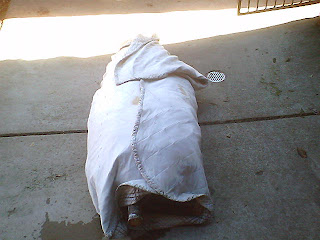
I just wrap up the tree like a piece of sausage, then removed the stand.

Into my car it goes.

And I drive down to one of the parks where trees can be dropped off for the mulcher. You can see trees and piles of free mulch in the background. The program where I live is run by the St. Louis City Parks & Rec Department.

And back to the Earth it goes. The farm will plant another one this Spring, this tree will decompose and break down into it's component compounds and return nutrients back to the Earth.
The cycle is complete.
From: J.N.
Sent: Wednesday, December 22, 2010 3:20 PM
To: info@realchristmastrees.org
Subject: Re: Fake Trees...
I read the christmas tree debate on your website and was mortified about what I learned regarding fake trees!!! Since a kid, my family ALWAYS bought fake trees...after the holiday, we'd store it in it's box and re-use it the following year. I'm now an adult and haven't had a tree in over 5 years, so this year I bought another fake pre-lit tree, about 4.5 feet tall. I never read about fake trees until now. It's disturbing to know that they have chemicals in them that can cause cancer...kinda makes me want to go home and throw out the one I have now (and i don't even like the stupid thing...it's not full..i added my own decorations and it's still has too many spaces in between)! Now knowing what I know, I'll get a real tree next year.
I was never really interested in a real tree because I always heard as a kid that you have to water it everyday because if it dries out, it can cause a fire... something like that. I also heard the pines fall off and just make a mess! When I used to put trees up, I'd let it stay until Jan. 3rd. This one is coming down and going in the trash on Dec. 26th!!!! So now you're telling me I have toxins all throughout the air in my house...gee just great..think I'll keep this from my sister (who lives with me, also an adult), until AFTER I take the tree down!!!!! I figure I spent 20 bucks on the stupid thing so I may as well keep it up until after xmas.
Jennifer
Thanks for sharing Jennifer. Yes, there are lots of crazy myths and misperceptions out there about Christmas trees.
Check out the photos from the tree lighting in Riga, Latvia. Here’s a note from the U.S. Embassy in Latvia http://on.fb.me/i1EB85
I am happy to tell you that yesterday we participated in the opening of the Find Yours! Project organized by Riga City Council. There are 25 countries/embassies participating in the project, and each country has its own Christmas tree. However, American Christmas tree is special due to our participation in the Christmas Tree Exchange project, as you know! Our PAO Amy Storrow was representing the U.S. Embassy during yesterday ceremony and giving the American Christmas tree as a gift to the city of Riga. Here is the link where you can view the pictures we took :
Tatjana Savranska
U.S. Embassy
Public Affairs Section
What a great celebration!
So in the final phase of following our “farm to home to recycle” tree, I recycled my tree this past week. Read earlier blog entries to learn about the The Rocks Tree Farm in New Hampshire where the tree was planted, raised and harvested. After it brought me enjoyment in my home this past holiday season, I took about an hour total out of my schedule to take the tree to be recycled. Here’s a series of photos showing this process.

Here's the tree after being taken outside my house. You'll notice a few things I'd recommend as tips. First, it's a good idea to let the water in the stand be absorbed the last few days or removed...the less still in there the better. Second, I use an old blanket to make carrying and transporting the tree easier and less messy.
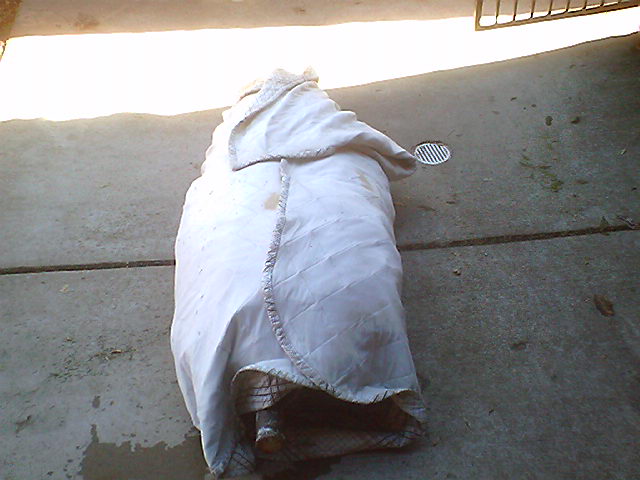
I just wrap up the tree like a piece of sausage, then removed the stand.

Into my car it goes.

And I drive down to one of the parks where trees can be dropped off for the mulcher. You can see trees and piles of free mulch in the background. The program where I live is run by the St. Louis City Parks & Rec Department.

And back to the Earth it goes. The farm will plant another one this Spring, this tree will decompose and break down into it's component compounds and return nutrients back to the Earth.
The cycle is complete.
Subscribe to:
Posts (Atom)

 Posts
Posts

